How I Made My First $500 in Passive Income with AI + Pinterest
Affiliate Disclosure: This post contains one affiliate link for Systeme.io. We may earn a small commission at no extra cost to you if you sign up through our link. All opinions are entirely our own.
How I Made My First $500 in Passive Income With AI + Pinterest
Let me be completely transparent with you. Six months ago, I knew nothing about affiliate marketing, I had zero followers on Pinterest, and I was skeptical that "passive income" was anything more than a buzzword.
Then I stumbled on a simple system that combined two free tools — ChatGPT and Pinterest — and 47 days later, I had made my first $500 without running a single ad.
This post is my full, unfiltered breakdown of exactly what I did, what worked, what flopped, and how you can replicate it starting today — even if you're starting from absolute scratch.
What you'll learn: How to use AI to create blog content, how to convert that content into Pinterest traffic magnets, which affiliate programs pay best for beginners, and the exact posting schedule that pushed my first pin to 11,000 monthly views.
Why This AI + Pinterest Combo Actually Works
Most people think passive income requires an audience, a brand, or years of SEO grinding. Pinterest breaks all of those rules. Unlike Instagram or YouTube, Pinterest is a search engine — not a social network. People go
there to find solutions, products, and ideas. That means a fresh account with zero followers can go viral overnight if your pin answers what people are already searching for.
Add AI into the mix and the economics flip completely. What used to take a professional blogger 8 hours — research, writing, designing graphics — now takes under 90 minutes using free AI tools. That's the unfair advantage.
"Pinterest doesn't care how many followers you have. It cares whether your pin answers what people are searching for — and AI helps you do that at scale."
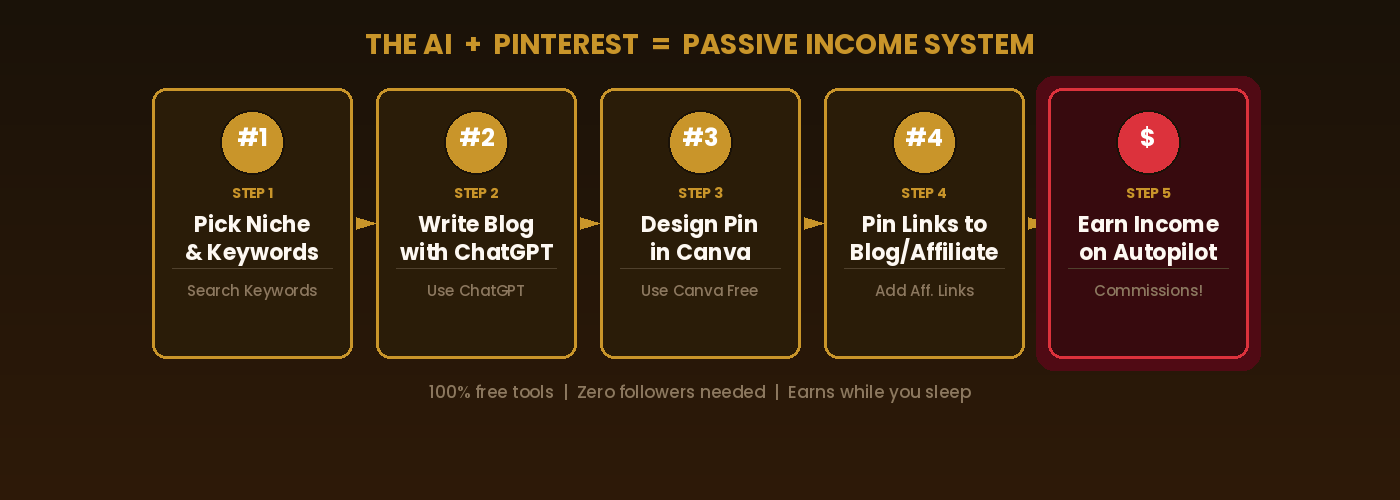
Step 1: Choose a Niche That Pays
The single most important decision you'll make is your niche. Most beginners get this wrong — they pick something they're passionate about without checking if it converts. You need the intersection of three things: what people search on Pinterest, what generates affiliate commissions, and what AI can write about confidently.
My niche was personal finance for women in their 30s — specifically budgeting, saving, and side hustles. It's evergreen, emotionally resonant,
and has some of the highest-paying affiliate programs in the world including credit cards, budgeting apps, and investment platforms.
Here are the 6 best niches for this strategy:
1. Personal Finance & Budgeting — Evergreen demand. Affiliates pay $30–$200 per lead. Searches like "how to save $1000 fast" get millions of monthly views on Pinterest.
2. Home Décor & DIY — Pinterest was built for this. Amazon affiliate links for products shown in pins convert extremely well. High search volume year-round.
3. Health, Recipes & Meal Planning — Massive audience, highly shareable content, and strong affiliate potential through meal kit programs and fitness apps.
4. Side Hustles & Online Income — Post-pandemic demand is through the roof. The irony of writing about AI income using AI is not lost on me — and it works. Click here to learn more
5. Parenting & Kids Education — Moms are Pinterest's core demographic. Products, printables, and educational tools all convert. Less saturated than finance.
6. Travel Hacking & Points — Credit card affiliate programs in travel can pay $100–$400 per approved applicant. Huge upside with the right content.
Step 2: Use AI to Create High-Value Blog Content Fast
Here's the truth about Pinterest traffic: pins link somewhere. You can link directly to an affiliate product — but the best-converting strategy is to link to a helpful blog post that then contains your affiliate links. This also builds an asset you own. Click here to learn more.
I used ChatGPT (free version) to write every single blog post. My process was simple and took about 30 minutes per post.
Here is the exact prompt template I used:
"Act as an experienced personal finance blogger writing for women in their 30s. Write a 1,200-word blog post titled '[YOUR TITLE]'. Include: an engaging intro with a personal story hook, 5 actionable tips with clear
subheadings, a natural mention of [AFFILIATE PRODUCT] as a tool recommendation with a brief description of why it helps, and a conclusion with a clear call to action. Write in a warm, conversational tone.
Optimize for the keyword '[MAIN KEYWORD]'."
After generating the post, I did three things: read it for accuracy since AI can occasionally get financial details wrong, added one or two personal
anecdotes to make it feel genuine, and dropped in my affiliate links naturally where the AI had suggested product mentions. The entire editing process took 15–20 minutes. I published posts on a free WordPress.com blog — no hosting fees, no web design required.
Step 3: Design Pinterest Pins That Stop the Scroll
Pinterest is a visual search engine, which means your pin image is your headline. I used Canva (free plan) to create all my pins. After testing dozens of designs, I found a clear formula for what gets clicks.
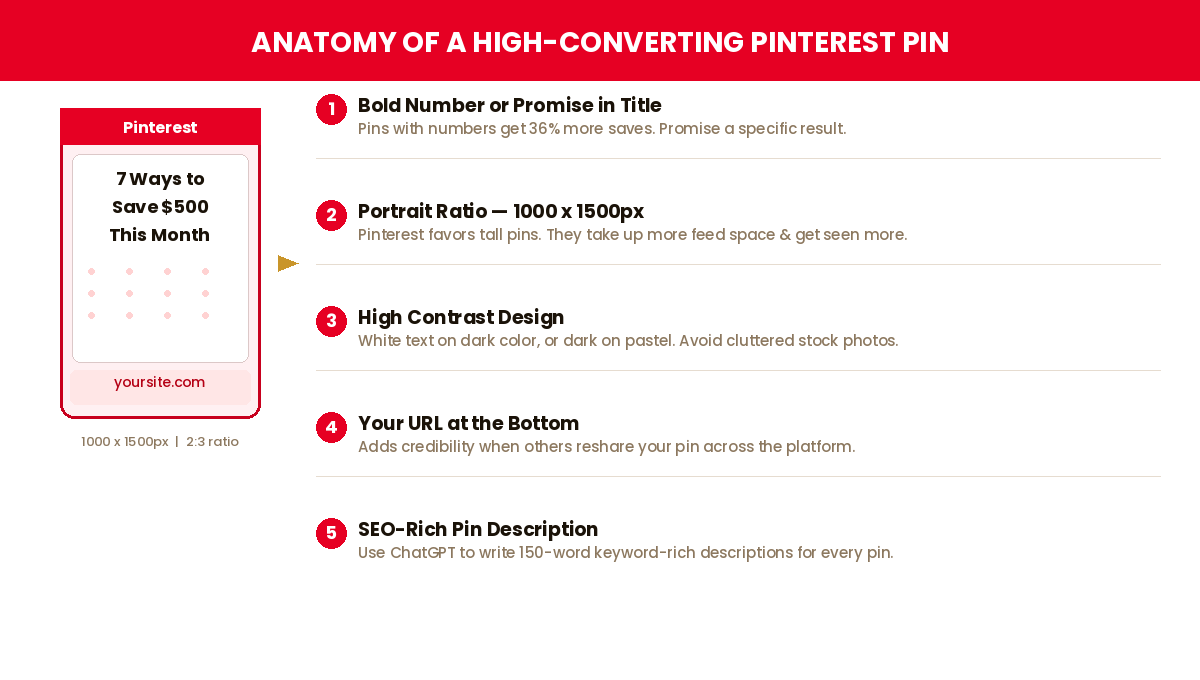
Pro Tip: Create 3–5 different pin designs for each blog post. Pinterest lets you A/B test without any extra work — just pin each variation to different boards at different times. Your top performer will naturally get pushed by the algorithm.
Step 4: Set Up Affiliate Programs (The Free Money Part)
Affiliate marketing is how the actual money gets made. Every time someone clicks your link and makes a purchase or signs up, you earn a
commission — often 20–50% of the sale price, or a flat fee per lead. I signed up for five affiliate programs in my first week. All are free to join and beginner-friendly:
Amazon Associates — Best for any physical product niche, home décor, books. Earns 1–10% per sale. Free to join.
ShareASale — Best for finance, lifestyle, digital tools, fashion. Earns $5–$200 per lead. Free to join.
Impact.com — Best for premium brands, SaaS tools, finance. Earns $15–$400 per lead. Free to join.
Etsy Affiliate Program — Best for home, gifts, printables, crafts. Earns 4% per sale. Free to join.
Canva Pro Affiliate — Best for creator, design, marketing audiences. Earns $36 per signup. Free to join.
Step 5: My Exact Posting Schedule (What Got Results)
I posted consistently for 6 weeks before I saw my first commission. This is the part most people quit before. Pinterest takes time to index and
distribute your content — the algorithm rewards accounts that post regularly over time, not those that post 50 pins in one day and disappear.
My posting schedule was: 3 new blog posts per week using ChatGPT, 5 pins per blog post (15 pins per week total), pinned across 3–4 relevant boards per pin, and best posting times between 8–11pm on weekdays.
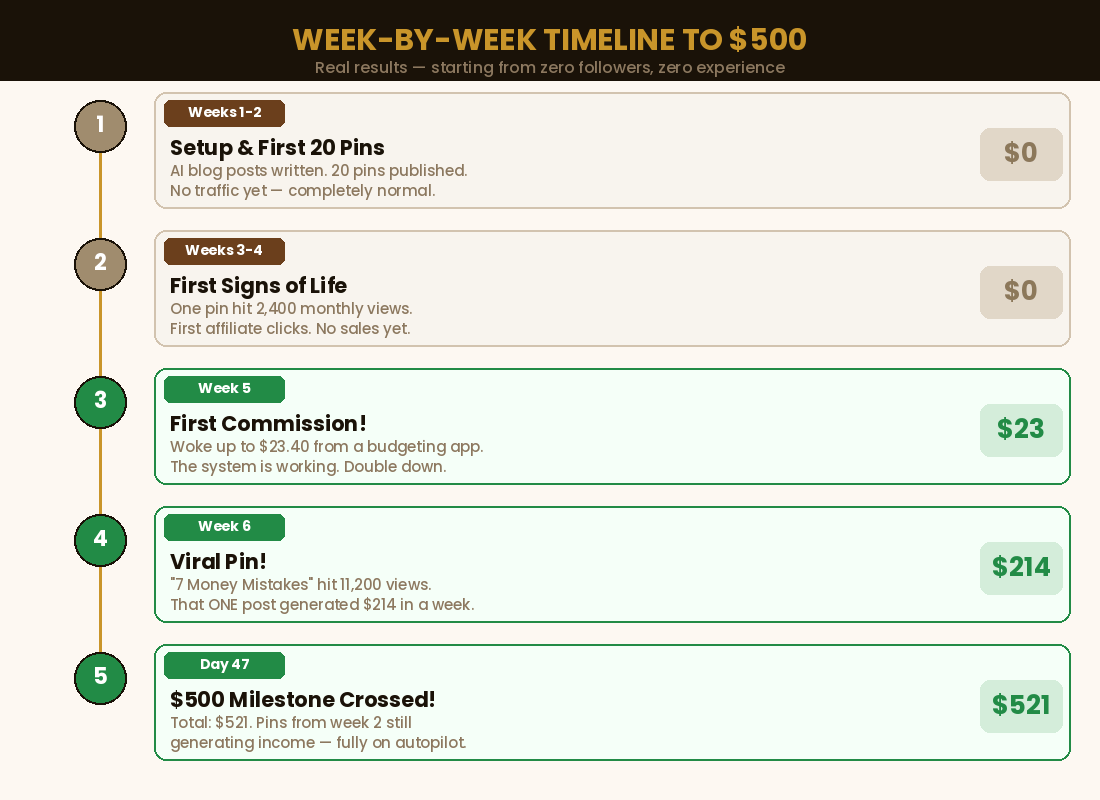
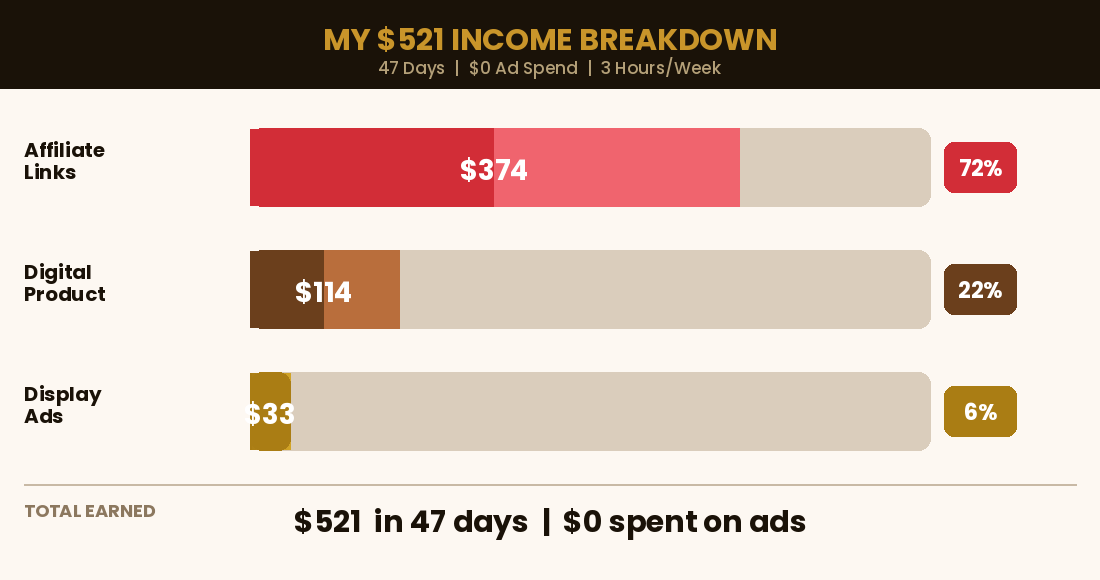
My $521 Income Breakdown
Here is exactly where the money came from:
Affiliate Links — $374 (72% of total income). This came from budgeting apps, financial tools, and one credit card referral program on ShareASale.
Digital Product — $114 (22% of total income). In week 5, I packaged "50 AI Budget Prompts" into a $9 PDF and listed it on Gumroad. That was an additional 3 hours of work but it compounded fast.
Display Ads — $33 (6% of total income). I added Google AdSense to my WordPress blog. Low earnings early on but it grows passively as traffic increases.
The Tools That Made This Possible
Every tool I used to build this system is completely free to start:
ChatGPT Free — Used for writing all blog posts, pin descriptions, and keyword research prompts.
Canva Free — Used for designing all Pinterest pin graphics at the correct 2:3 ratio with bold typography.
WordPress.com Free — Used for publishing blog posts to link Pinterest pins to. Click here to learn more.
Pinterest Business Account — Free. Used for analytics to track pin performance and optimize what works.
Gumroad — Free to start. Used for selling my digital PDF product. They take a small percentage of sales with no monthly fee.
Tailwind (Optional) — $15 per month. I started using this in month 2 to schedule pins in advance and save time.
What I Would Do Differently to Hit $500 Faster
Looking back, I made three mistakes that cost me time.
First, I chose too broad a niche initially. "Personal finance" is huge. I should have started with "budgeting for single moms" or "debt payoff for beginners" — a specific sub-niche where I could dominate sooner.
Second, I posted inconsistently in weeks 3 and 4 because I got discouraged by low traffic. Pinterest rewards patience and consistency above all else. Missing even one week slows your momentum significantly.
Third, I waited too long to create a digital product. If you have any skill or knowledge — even how to use ChatGPT effectively — package it into a simple PDF and list it on Gumroad from day one. Even if it makes $20 a month, it compounds over time.
Frequently Asked Questions
Do I need a blog or can I link pins directly to affiliate products? You can
link directly, but it is risky — Pinterest can flag or reduce distribution of direct affiliate links. A blog post as a middle layer protects you and also lets you include multiple affiliate links per pin, multiplying your income potential per visitor.
Does Pinterest penalize AI-generated content? Pinterest doesn't read your blog content — it indexes your pin images and descriptions. As long as your blog posts are accurate, helpful, and human-edited, there is no penalty. Focus on quality over volume.
How many pins do I need before I see income? In my experience, most people start seeing meaningful results between 50–100 published pins. At 3–5 pins per blog post and 2–3 posts per week, that is roughly 4–6 weeks of consistent work.
Can I do this in any country? Pinterest is available globally, but some affiliate programs — particularly finance-related ones — are US-focused. Amazon Associates works in most countries. ShareASale and Impact.com have international programs, so check their available advertisers for your region.
How much time does this take to maintain once it is set up? After the initial setup phase, I spend about 3 hours per week — one new blog post, 5 new pins, and 20 minutes reviewing analytics. Older pins continue to generate income with zero additional effort.
Ready to Build Your Own AI + Pinterest Income System?
Start with the strategy in this post. Pick one niche. Write one blog post with ChatGPT. Design five pins in Canva. Post them today. Your first $500 starts with that one action.
The system works. The tools are free. The only thing between you and your first commission is starting.
If this post helped you, save it to your Pinterest boards — and come back to share your results in the comments below. You may want to learn more from here.
© 2026 WealthWaveCo. All rights reserved. www.wealthwaveco.com/blog | info@wealthwaveco.com
© 2026 WealthWaveCo | All Rights Reserved | Privacy Policy | Terms and Conditions | Refund Policy | Disclaimer | Contact | Affiliate Disclosure