
How to Make $1,000 a Month on Pinterest Using Free AI Tools
Affiliate Disclosure: This post contains one affiliate link for Systeme.io. We may earn a small commission at no extra cost to you if you sign up through our link. All opinions are entirely our own.
How to Make $1,000 a Month on Pinterest Using Free AI Tools
Most people scroll Pinterest for recipe ideas or home décor inspiration. A small but growing group of people use it to quietly generate $500, $1,000, even $5,000 a month in passive income — without running a single ad, without showing their face, and without a large following.
The secret is a simple combination of free AI tools and Pinterest's unique algorithm. Unlike Instagram or TikTok, Pinterest is a search engine. Content posted today can drive traffic and income for months or even years. When you add AI into the mix, the time it takes to create that content drops from hours to minutes.
This post breaks down exactly how this system works, what income sources it taps into, and the step-by-step roadmap anyone can follow to realistically hit $1,000 a month starting from zero.
Why Pinterest Is the Best Free Traffic Source for Passive Income
Before diving into the strategy, it is worth understanding why Pinterest works so differently from every other platform.
On Instagram, a post has a lifespan of about 48 hours before it disappears in the feed. On TikTok, even viral videos fade within days. Pinterest pins, on the other hand, are indexed like web pages.
A well-optimized pin published today can appear in search results for two to three years and keep driving traffic and income the entire time.
This is what makes Pinterest perfect for passive income. You do the work once and the platform keeps distributing it long after you have moved on to your next piece of content.
Here is a real example of how this plays out. A blogger in the personal finance niche published a pin in January linking to a blog post about budgeting apps. By December of the same year, that single pin had
generated over 14,000 clicks to her blog and earned $340 in affiliate commissions — from one pin, published once, with zero ongoing effort.
That is the power of Pinterest as a long-term traffic engine.
Lorem ipsum dolor sit amet, consectetur adipisicing elit. Autem dolore, alias, numquam enim ab voluptate id quam harum ducimus cupiditate similique quisquam et deserunt, recusandae.
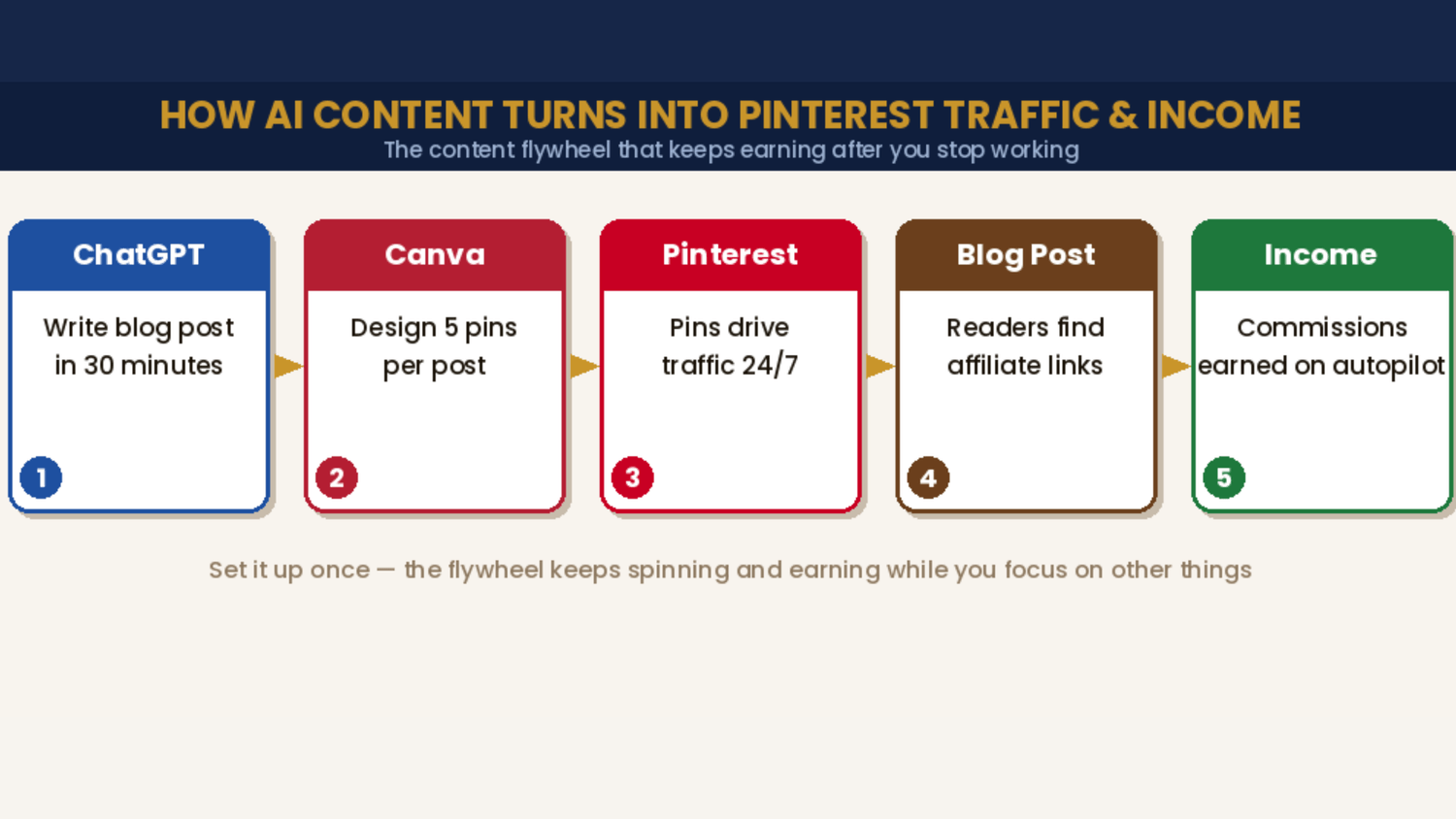
The Free AI Tools That Make This Work
The reason this strategy is accessible to anyone is that every tool you need is completely free to start. Here is what the full toolkit looks like:
ChatGPT Free — This is your content engine. Use it to research keywords, write full blog posts in under 30 minutes, generate pin descriptions, brainstorm post ideas, and even write email sequences once your list starts growing. Click here to learn more.
Canva Free — This is your design tool. Canva's free plan includes everything you need to create professional-looking Pinterest pins at the correct 2:3 ratio. There are hundreds of Pinterest templates built in, and customizing them takes under 10 minutes per pin.
WordPress.com Free — This is where your blog lives. Every Pinterest pin needs to link somewhere, and a free WordPress blog is the cleanest and most credible destination. It also lets you place multiple affiliate links inside a single post, multiplying your income per visitor.
Pinterest Business Account Free — Upgrading your Pinterest account to a Business account is free and unlocks Pinterest Analytics. This shows you exactly which pins are driving traffic so you can double down on what is working.
Google AdSense Free — Once your blog traffic grows, AdSense automatically displays ads on your posts and pays you per view. It starts small but compounds significantly as your Pinterest traffic grows month over month. Click here to learn more.
The $1,000 a Month Income Mix
One of the biggest mistakes beginners make is relying on a single income source. The fastest path to $1,000 a month on Pinterest is combining three streams that all feed from the same traffic.
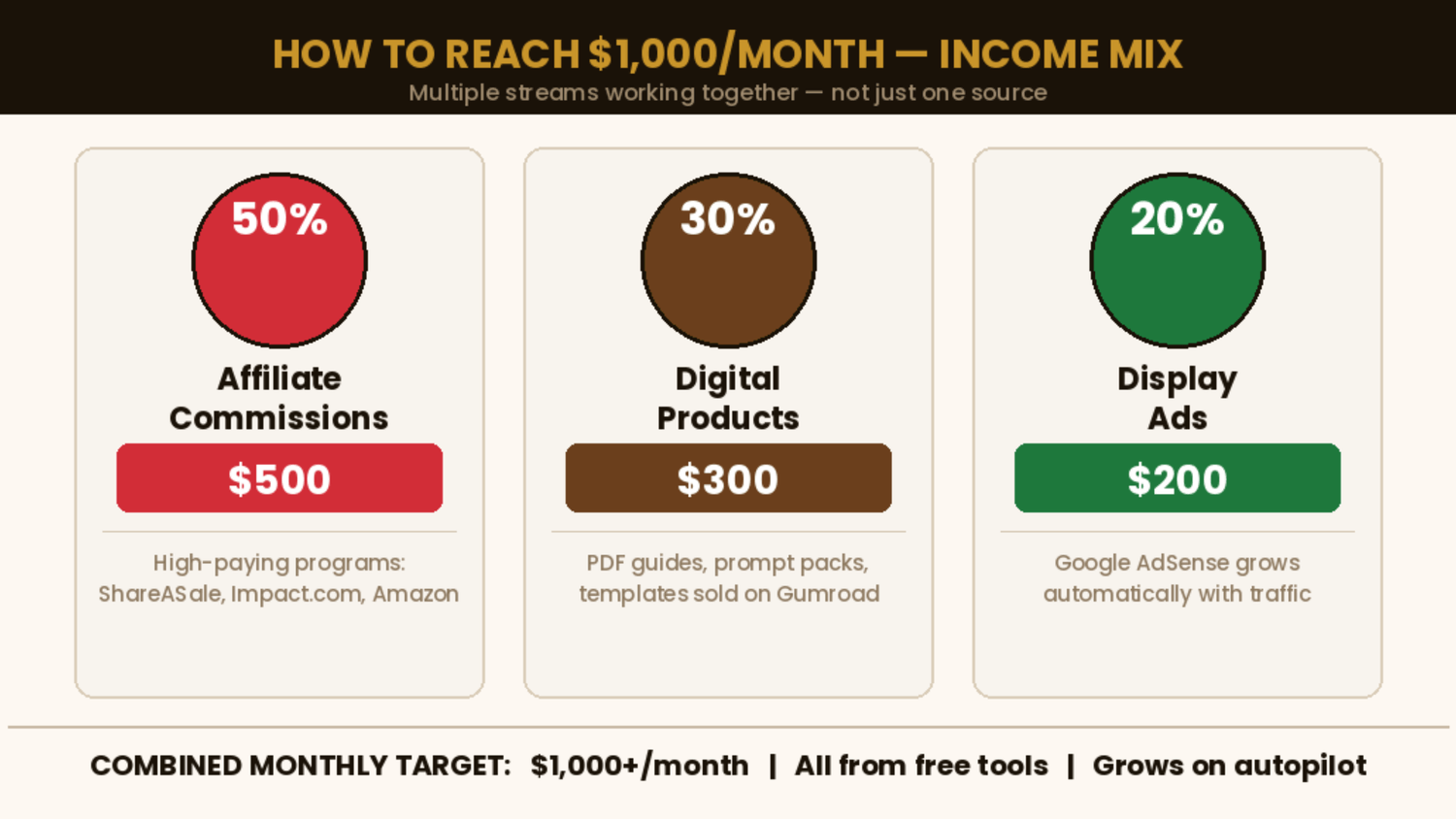
Affiliate commissions make up the largest portion — around $500 of the monthly target. This comes from recommending products and tools inside your blog posts through programs like ShareASale, Impact.com,
and Amazon Associates. Every time a reader clicks your link and makes a purchase or signs up, you earn a commission. High-performing niches like personal finance, software tools, and online education can pay anywhere
from $15 to $200 per referral.
Digital products account for roughly $300 of the monthly target. This means creating a simple PDF guide, prompt pack, checklist, or template
and selling it on a free platform like Gumroad. The beauty of digital products is that they cost nothing to produce beyond your time, have zero fulfilment costs, and can sell around the clock without any
involvement from you. A $15 prompt pack sold to 20 people a month generates $300 with no ongoing effort. Click here to learn more.
Display advertising fills the remaining $200. Once your blog receives consistent traffic from Pinterest, Google AdSense and similar ad networks
pay you simply for visitors viewing your pages. It starts slow but grows passively as your pin library expands and older pins continue driving traffic.
The Pinterest Keyword Strategy That Drives Free Traffic
The single most important skill in this entire system is knowing how to use keywords on Pinterest. Pinterest is not just a visual platform — it is a keyword-driven search engine, and every element of your pin needs to be optimized if you want it to appear in search results.
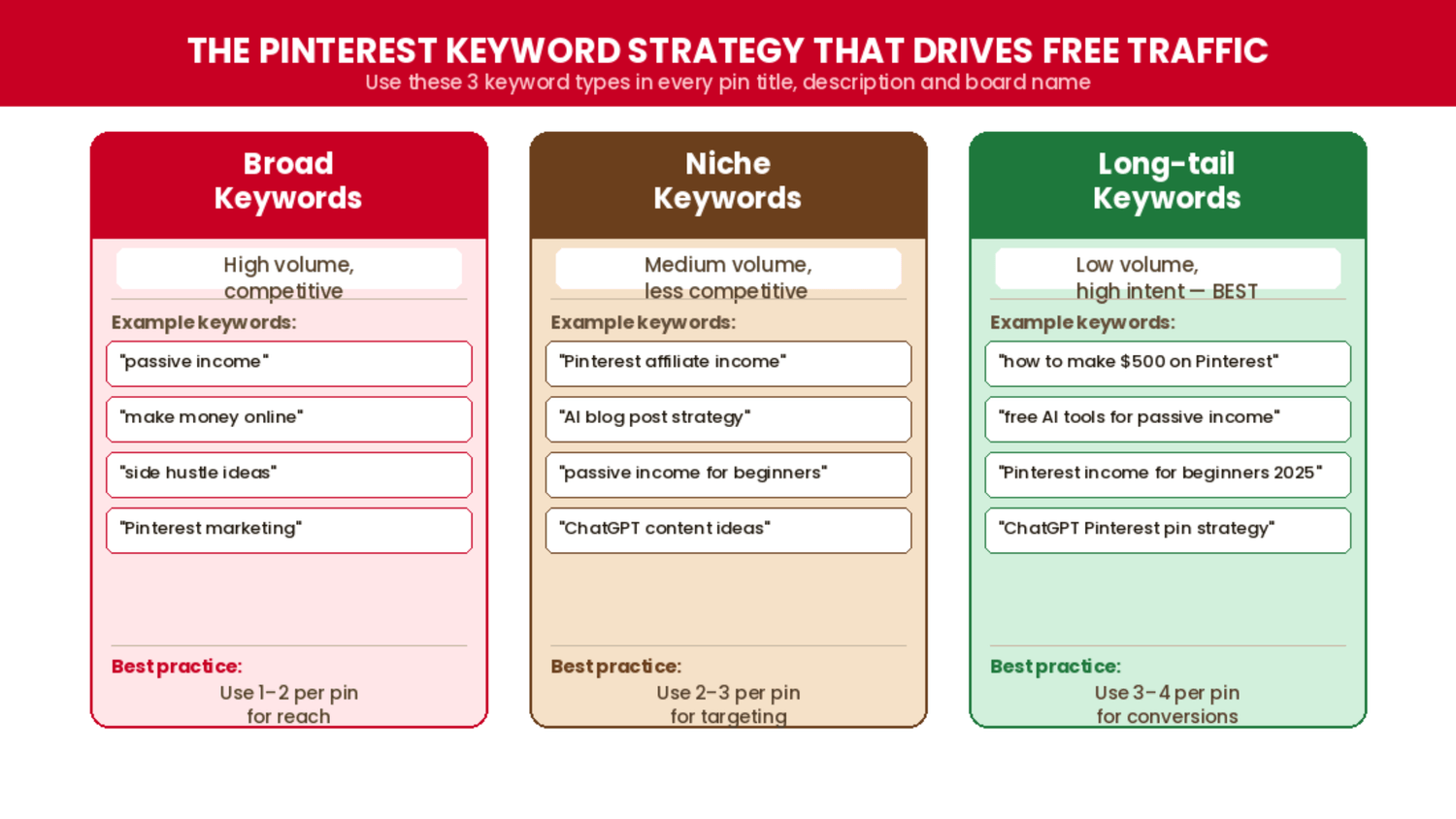
There are three keyword types to use in every pin you publish. Broad keywords like "passive income" and "make money online" have massive search volume but also high competition. Niche keywords like "Pinterest
affiliate income" and "AI blog post strategy" are more specific and easier to rank for. Long-tail keywords like "how to make $500 on Pinterest" and "free AI tools for passive income 2025" have lower volume but attract
people who are ready to take action — and these convert the best.
The winning formula is to use one broad keyword, two niche keywords, and three to four long-tail keywords in every pin title and description. Use
ChatGPT to generate these keyword combinations in seconds with a prompt like: "Give me 10 long-tail Pinterest keywords for a blog post about making passive income with AI tools."
The 90-Day Roadmap to $1,000 a Month
Reaching $1,000 a month with this strategy is a realistic 90-day target if you follow a structured plan. The key is to break it into three phases rather than trying to do everything at once.
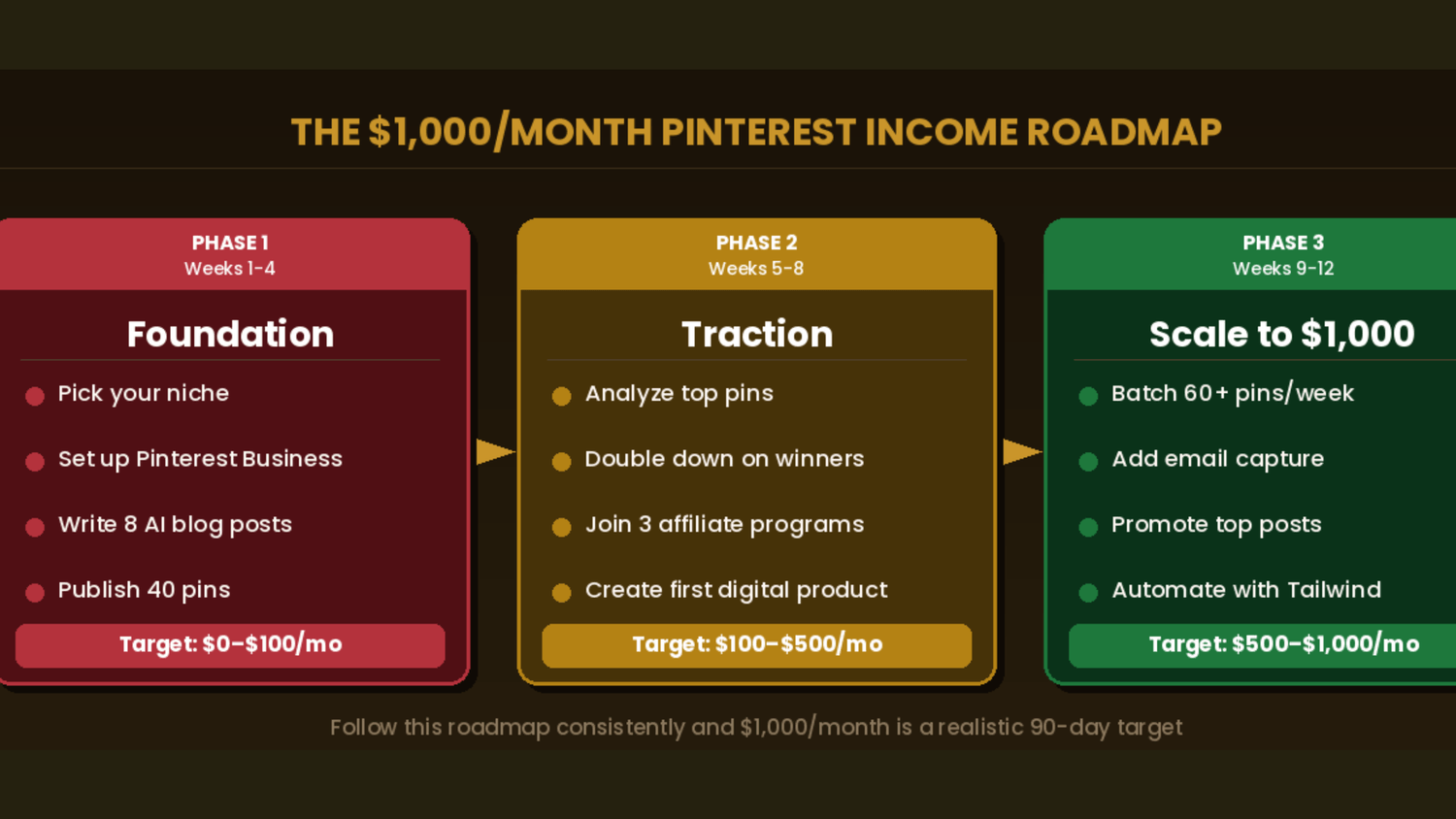
Phase 1 covers weeks one through four and is all about building the foundation. During this phase the focus is on picking a profitable niche, setting up a Pinterest Business account, writing eight AI-powered blog
posts, and publishing 40 pins — five per post. Most people will earn little to nothing in this phase, and that is completely normal. You are building the infrastructure that the income machine runs on.
Phase 2 covers weeks five through eight and is where you start seeing real traction. By now Pinterest Analytics will show you which pins are getting impressions and clicks. Double down on those topics and styles.
Join three affiliate programs that match your niche. Create your first simple digital product — even a basic 10-page PDF guide — and list it on Gumroad.
Phase 3 covers weeks nine through twelve and is the scaling phase. Increase your pin output to 60 or more per week by batching your content creation. Add an email capture form to your blog so visitors can
subscribe — this builds an audience you own. Start using Tailwind to schedule pins in advance so the system runs with minimal daily input from you. Click here to learn more.
What Happens After 90 Days
The compounding nature of this system is what makes it genuinely passive over time. Each new pin you publish adds to a library that keeps driving traffic indefinitely. Each new blog post adds more affiliate links
earning commissions around the clock. Each new email subscriber becomes a future customer for your digital products.
Creators who stay consistent with this strategy for six months typically
report monthly earnings between $800 and $2,500 — all from content created during those first 90 days continuing to perform on autopilot.
The work you put in during weeks one through twelve does not stop
working when you do. That is the core principle behind building wealth on autopilot, and it is exactly why Pinterest combined with AI is one of the most powerful free income strategies available today.
Common Mistakes to Avoid
Trying to be on every platform at once is the fastest way to burn out and see no results. Focus on Pinterest alone until you hit $500 a month, then consider expanding.
Posting inconsistently kills momentum. Pinterest rewards accounts that publish regularly. Even five pins a week is better than fifty pins in one day followed by two weeks of silence.
Ignoring analytics means you are guessing instead of growing. Check Pinterest Analytics every week and create more content around your top-performing pins. Let the data tell you what to make next.
Promoting only expensive products is a mistake. Readers trust recommendations more when they include a mix of free tools and paid products. Build trust first, then monetize.
Frequently Asked Questions
How long does it take to make $1,000 a month on Pinterest? Most consistent creators reach this target within 60 to 90 days of starting. The key word is consistent — publishing pins daily and writing new blog posts
every week is what accelerates results.
Do I need a lot of Pinterest followers to make money? No. Pinterest distributes content based on keywords and engagement, not follower
count. Accounts with fewer than 100 followers regularly have pins reaching tens of thousands of people every month.
Can I do this without showing my face or using my real name? Absolutely.
Many of the most successful Pinterest income creators are completely faceless. Your brand, your content, and your strategy are what matter — not your identity.
How many pins do I need before I see consistent income? A library of 100 to 150 published pins is generally where income becomes consistent and predictable. At five pins per blog post and two posts per week, you reach
that number in about 15 weeks.
Is this strategy still working in 2025? Yes. Pinterest continues to grow its user base and its algorithm still favors fresh, keyword-rich content
regardless of account age or follower count. The opportunity is arguably bigger now than it was two years ago.
Start Building Your Pinterest Income Machine Today
The tools are free. The strategy is proven. The only variable is whether you start today or keep waiting for the perfect moment.
Pick your niche. Write your first blog post with ChatGPT. Design five pins
in Canva. Publish them today. That single action puts you ahead of everyone still thinking about it.
Building wealth on autopilot is not a myth — it is a system. And now you
have the full blueprint.
If this post helped you, save it to your Pinterest boards and share it with someone who needs a practical income strategy that actually works.
About Wealth Wave Co
WealthWaveCo is a passive income education brand helping everyday people build wealth on autopilot using free AI tools, Pinterest, and smart content strategies. No fluff. No gimmicks. Just real strategies that work — even if you are starting from zero. Learn more at wealthwaveco.com/blog
© 2026 WealthWaveCo. All rights reserved. www.wealthwaveco.com/blog | info@wealthwaveco.com
© 2026 WealthWaveCo | All Rights Reserved | Privacy Policy | Terms and Conditions | Refund Policy | Disclaimer | Contact | Affiliate Disclosure