
Why Your High Salary Is Losing Value — The Hands-Off Passive Income Guide for Professionals
Affiliate Disclosure: This post contains one affiliate link for Systeme.io and Gumroad. We may earn a small commission at no extra cost to you if you sign up through our link. All opinions are entirely our own.
Financial Disclaimer: This article is for educational and informational purposes only and does not constitute financial, investment, legal, or tax advice. Please consult a qualified financial adviser before making any investment decisions.
Introduction: The High-Income Wealth Illusion
There exists a pervasive and costly misconception in professional circles: that earning a high salary is, in itself, a wealth-building strategy.
It is not.
A high salary is an income event — a recurring cash flow that, without deliberate strategic deployment, does not compound, does not generate passive returns, and does not protect itself against the two most persistent threats to financial security: inflation and taxation.
For doctors, lawyers, and corporate managers — professionals who have invested a decade or more of education, training, and career development into reaching the higher end of the income spectrum — this misconception represents a structural risk that quietly erodes financial security year by year, pound by pound.
This article presents the complete framework from our guide, The Passive Income Professional: The Hands-Off Wealth Guide for Doctors, Lawyers and Corporate Managers — an evidence-based system for converting stagnant savings into productive, income-generating assets, without consuming the one resource your career already demands in abundance: time.
Important: Nothing in this article constitutes personalised financial advice. Before implementing any strategy discussed here, consult a qualified financial adviser, tax professional, or legal counsel who can assess your specific circumstances.
The Wealth Erosion Crisis — Why Idle Capital Is an Active Liability
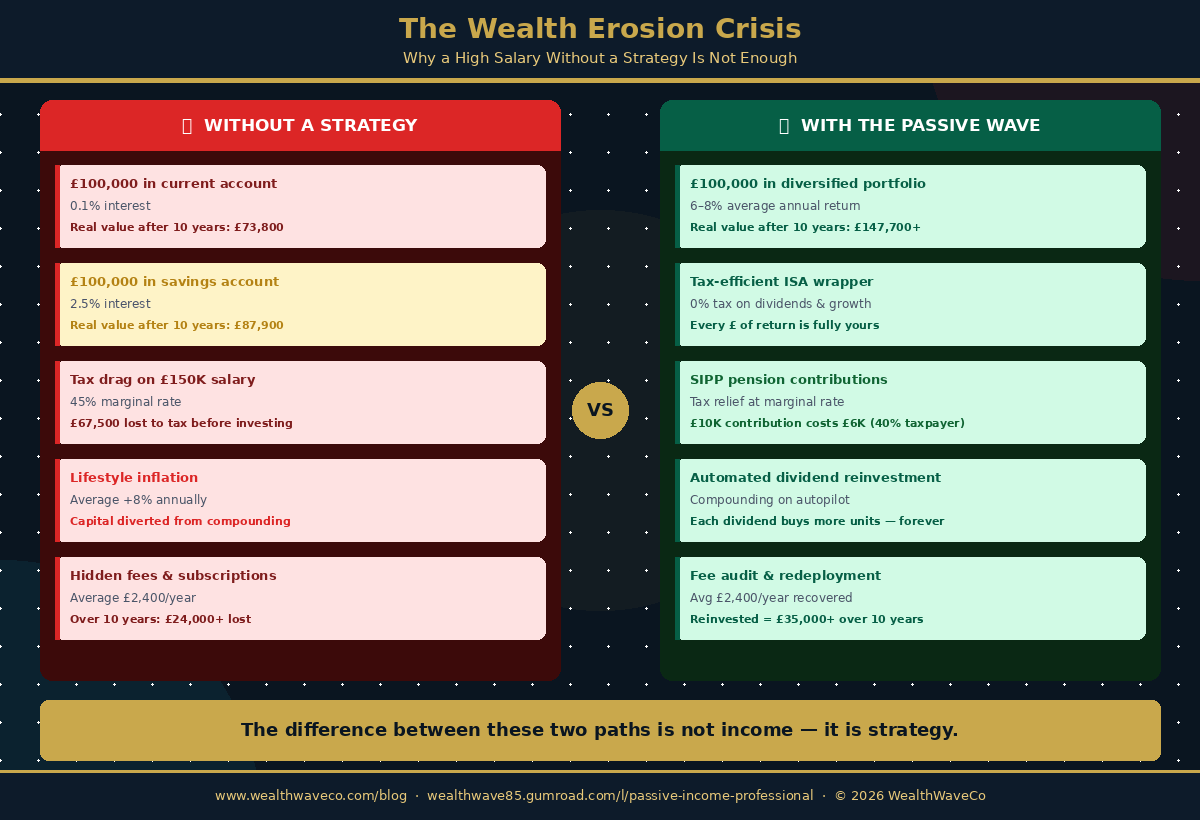
The concept of wealth erosion is straightforward in principle but frequently underestimated in practice. At a 3% annual inflation rate — a conservative estimate for most developed economies — £100,000 held in a standard current account loses approximately £3,000 in real purchasing power every single year. Over a decade, that represents a real-terms loss exceeding £26,000, without a single pound being spent.
This is not a theoretical risk. It is the financial reality facing the majority of high-income professionals whose savings sit in low or zero-yield accounts while their professional obligations prevent them from engaging with their finances strategically.
Three structural mechanisms accelerate this erosion:
Tax Drag: High earners occupy the highest marginal tax brackets, meaning a disproportionate share of every additional pound earned is lost before it can be deployed.
A professional earning £150,000 annually loses £67,500 or more to income tax and national insurance contributions before a single pound reaches their savings account. Without deliberate tax-efficiency strategies — ISAs, SIPPs, pension maximisation — the effective return on active income is severely compressed.
Lifestyle Inflation: Income growth in high-earning professions is frequently matched — and sometimes exceeded — by proportional lifestyle expansion. Larger homes, premium vehicles, private schooling, and luxury travel represent understandable expressions of professional achievement, but also represent capital that could otherwise be compounding in productive assets. The discipline of separating consumption from investment is central to long-term wealth accumulation.
Subscription and Fee Erosion: The least visible but genuinely significant wealth leak is the accumulation of recurring financial costs: high-fee investment products, unnecessary insurance premiums, unused professional memberships, and legacy direct debits. Individually, these represent minor expenditures. Cumulatively — compounded over a decade — they represent a material drag on net worth.
The WealthWave Principle: Wealth is not built by earning more. It is built by deploying what you earn into assets that generate returns independently of your working hours.
The 3 Pillars of Passive Income for Professionals
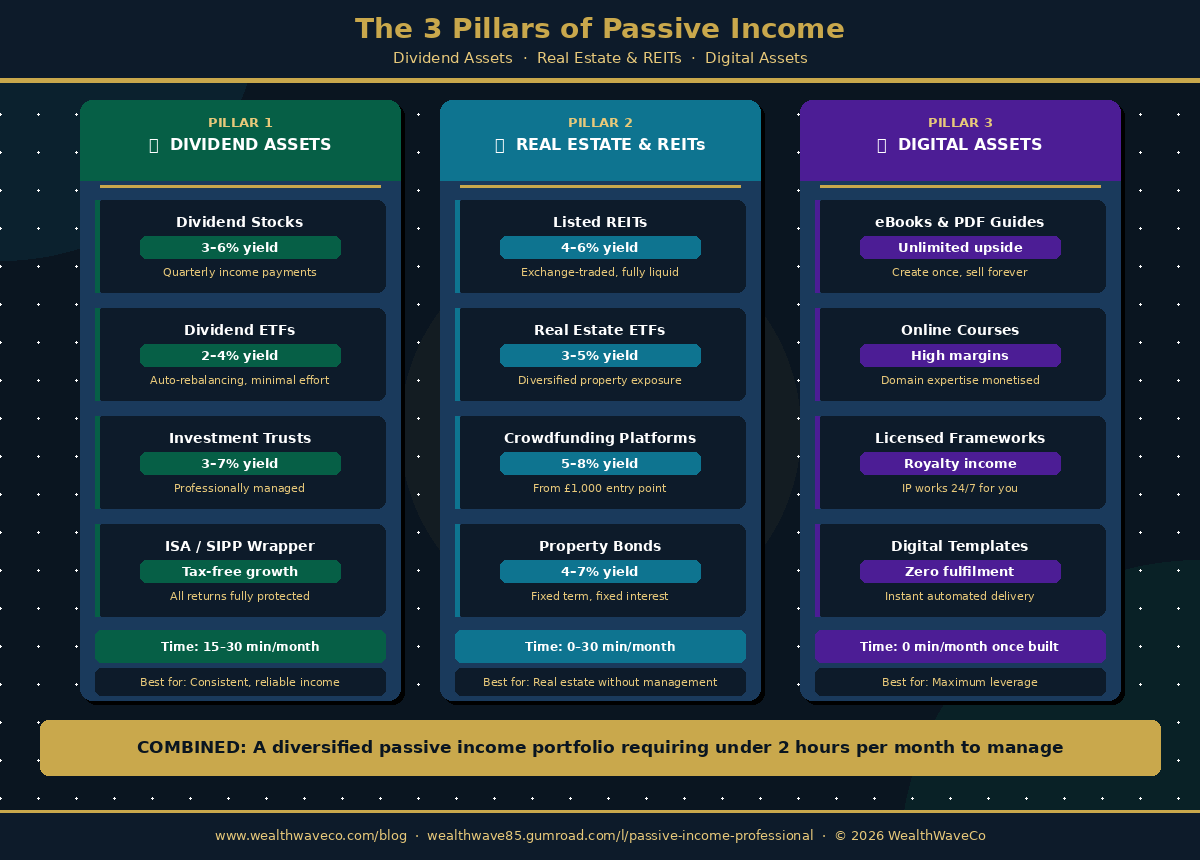
For high-earning professionals with limited time, the most appropriate passive income vehicles share three essential characteristics: they are scalable, they are liquid or semi-liquid, and they can be managed within a constrained time budget.
The following three pillars represent the most accessible and evidence-supported categories.
Pillar 1 — Dividend Assets
Dividend-paying equities and funds represent the most accessible entry point into passive income for the majority of professionals. They require no specialist knowledge beyond initial selection, no active management beyond periodic rebalancing, and can be held within tax-efficient wrappers that eliminate the primary friction cost of investment income: taxation.
How it works: companies distribute a portion of their profits to shareholders as dividends — typically quarterly or annually. By constructing a diversified portfolio of dividend-paying equities or dividend-focused index funds, an investor can generate a predictable, recurring income stream that requires no active involvement.
Historical dividend yields across diversified portfolios have ranged from 2% to 6% annually, depending on the composition and risk profile selected.
Note: Past yields are not indicative of future returns. All investments carry risk. Consult a qualified financial adviser before investing.
Pillar 2 — Real Estate and REITs
Direct property ownership — with its management demands, maintenance responsibilities, and illiquidity — is frequently incompatible with the time constraints of a demanding professional career. Real Estate Investment Trusts resolve this incompatibility entirely.
A REIT is a listed company that owns and manages income-producing real estate on behalf of shareholders, distributing the majority of its rental income as dividends.
Shareholders receive the income benefits of real estate exposure — historically one of the most reliable wealth-building asset classes — without any of the management responsibilities. Listed REITs are exchange-traded, meaning they can be bought and sold as easily as any equity, and held within an ISA wrapper for complete tax efficiency.
Note: Investment in REITs and real estate vehicles carries risk including potential capital loss and income variability. Independent financial advice is strongly recommended.
Pillar 3 — Digital Assets and Intellectual Property
The third pillar represents the highest-leverage passive income category available to professionals in the modern economy. For individuals with deep domain expertise — medical knowledge, legal frameworks, financial understanding, or management methodology — the creation of a single high-quality digital resource represents a genuinely scalable income stream that requires no ongoing time investment beyond initial creation.
An e-book, online course, template, or licensed framework can be created once and sold an unlimited number of times, with zero marginal cost per additional unit.
The compounding advantage is significant: the 1,000th sale costs identically to the first — nothing.
For professionals exploring digital passive income creation, our complete framework library is available at www.wealthwaveco.com/blog.
The Sleep Score Framework — Choosing Assets Based on Your Risk Psychology
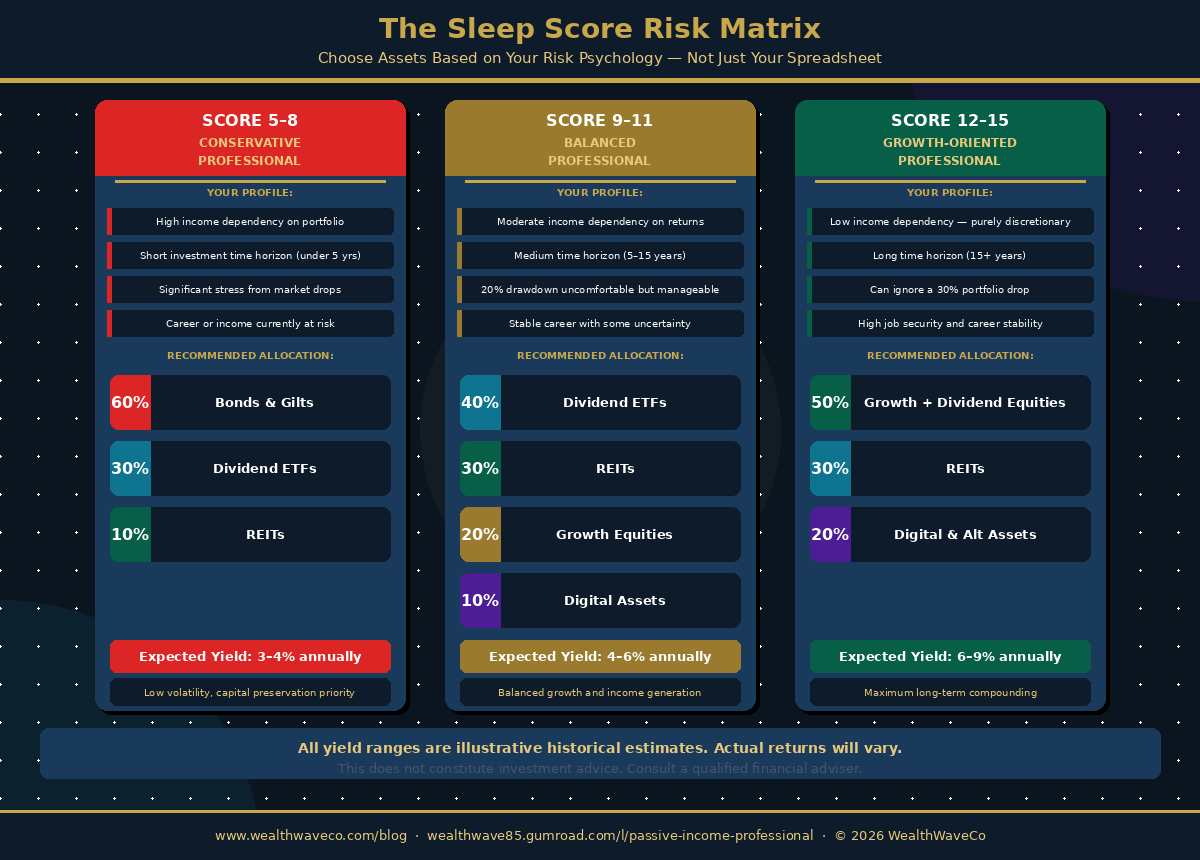
The concept of risk tolerance is frequently oversimplified in mainstream financial literature to a binary choice between aggressive and conservative. For high-earning professionals — whose primary wealth-building asset is their earning capacity and career performance — a more nuanced framework is required.
The Sleep Score is a practical risk assessment that measures how much portfolio volatility you can absorb without material impact on your professional performance, decision-making, or personal wellbeing. It acknowledges that an investment's true risk is not merely its standard deviation of returns — it is the psychological and behavioural impact of that volatility on the investor.
A professional who checks their portfolio daily and experiences significant stress during market downturns is not a balanced investor — regardless of what their risk questionnaire suggests.
A portfolio that performs well on paper but causes professional disruption due to psychological stress is, by any practical definition, an unsuitable portfolio.
To calculate your Sleep Score, honestly rate yourself from 1 to 3 on five dimensions: your sensitivity to portfolio volatility, your drawdown tolerance, your income dependency on investment returns, your investment time horizon, and your career and income stability. Your total score — ranging from 5 to 15 — determines your recommended asset allocation profile.
Note: All yield ranges referenced in this framework are illustrative historical estimates. Actual returns will vary. This does not constitute investment advice.
Tax Optimisation — Keeping More of What You Earn
For high-income professionals, the most immediately actionable lever for improving net investment returns is not asset selection — it is tax efficiency.
The difference between holding investments in a taxable account versus a tax-efficient wrapper can represent several percentage points of annual return, compounded indefinitely.
The Professional Tax Efficiency Hierarchy prioritises available mechanisms in order of impact:
Tier 1 — Pension Contributions (SIPP/Workplace Pension): Pension contributions attract full income tax relief at your marginal rate. For a higher-rate taxpayer, a £10,000 pension contribution costs effectively £6,000.
The annual allowance is currently £60,000, subject to tapering for very high earners. This is the single most powerful tax efficiency tool available to UK professionals.
Tier 2 — Stocks and Shares ISA: An ISA allows up to £20,000 per tax year to be invested in a completely tax-free environment — no income tax on dividends, no capital gains tax on growth, and no reporting requirements
.
Tier 3 — Venture Capital Trusts and EIS: For professionals with higher risk appetite and significant taxable income, these instruments offer substantial upfront income tax relief alongside capital gains tax exemptions. They carry considerably higher risk and illiquidity, and should only be considered following specialist advice.
Tier 4 — Limited Company and Holding Structures: For self-employed professionals or those with significant portfolios, structured holding arrangements can offer corporation tax advantages and greater profit extraction flexibility. This requires specialist legal and accountancy guidance.
All tax strategies must be implemented in compliance with applicable legislation and in consultation with a qualified tax professional. Tax legislation changes frequently and varies by individual circumstances. For regular updates on tax-efficient investment vehicles, visit www.wealthwaveco.com/blog.
The Hands-Off Wealth Timeline — From Idle Capital to a Self-Running Income Engine
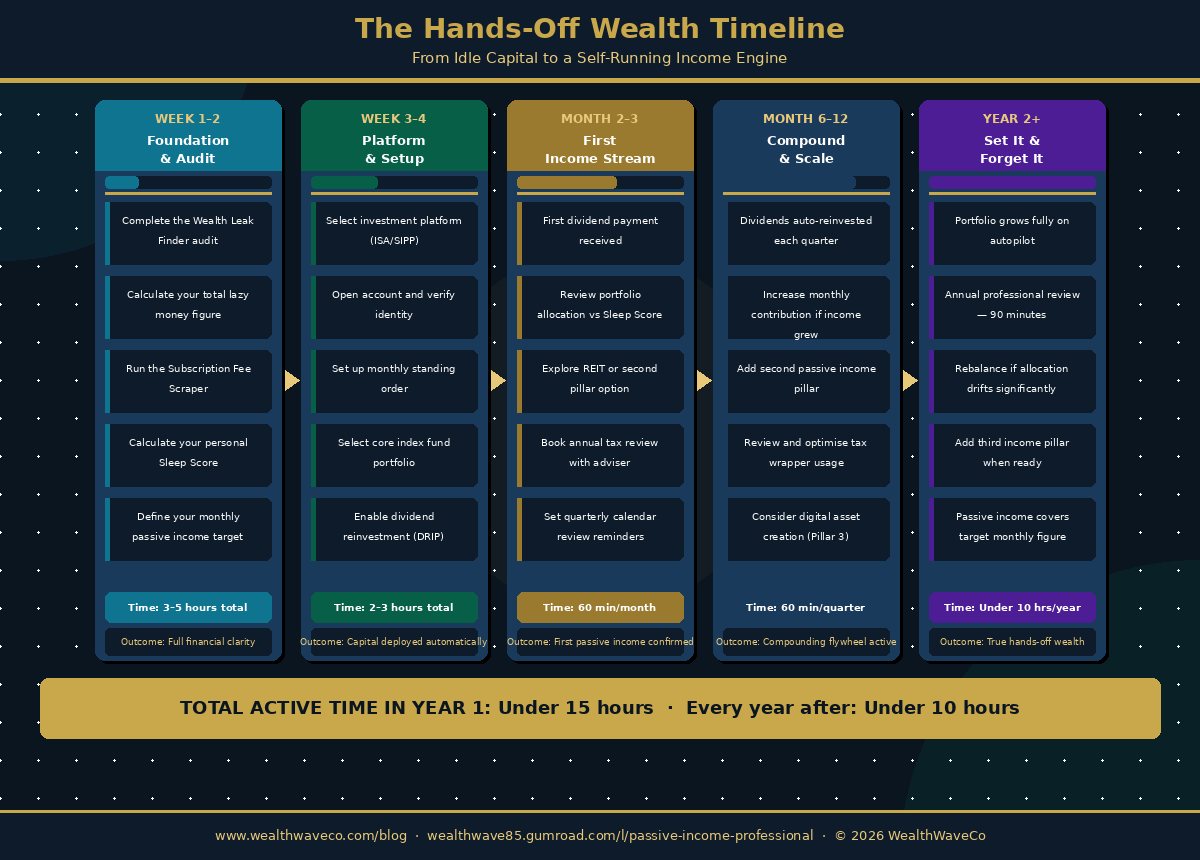
The complete implementation journey — from initial financial audit to a fully automated, self-running passive income infrastructure — requires less active time than most professionals assume.
Weeks 1–2 — Foundation and Audit: Complete the Wealth Leak Finder audit, calculate your total lazy money figure, run the Subscription Fee Scraper to identify recoverable recurring costs, calculate your Sleep Score, and define your monthly passive income target. Total time investment: 3 to 5 hours.
Weeks 3–4 — Platform and Setup: Select your investment platform, open your ISA or SIPP account, establish your monthly standing order, select your core index fund portfolio, and enable automatic dividend reinvestment. Total time investment: 2 to 3 hours.
Months 2–3 — First Income Stream: Receive your first dividend payment, review your portfolio allocation against your Sleep Score, explore your second passive income pillar, and schedule your annual tax review with your adviser. Ongoing time: 60 minutes per month.
Months 6–12 — Compound and Scale: With dividends auto-reinvested each quarter and contributions continuing automatically, your portfolio begins compounding. Increase your monthly contribution if income has grown and add your second passive income pillar. Ongoing time: 60 minutes per quarter.
Year 2 and Beyond — Set It and Forget It: Your portfolio grows on autopilot. An annual professional review of 60 to 90 minutes ensures tax wrapper optimisation and allocation alignment. Total active management time: under 10 hours per year.
The result: A complete passive income infrastructure that works continuously and independently, requiring less annual management time than a single working day.
Your Complete Guide — Available Now
Every framework, tool, and strategy covered in this article — the Wealth Erosion analysis, the 3 Pillars of Passive Income, the Sleep Score framework, the Tax Optimisation hierarchy, the Set-It-and-Forget-It portfolio setup, and the printable Wealth Leak Finder audit — is contained in full, actionable detail in our 16-page professional guide.
Available for instant download on Gumroad. For in-depth investment breakdowns, strategy articles, and free resources, visit
www.wealthwaveco.com/blog. For consultation enquiries, contact info@wealthwaveco.com.
Recommended Tools
Systeme.io — All-in-one platform for building automated income funnels and email sequences:
Vanguard UK — Low-cost index funds and ISA accounts: vanguard.co.uk
Hargreaves Lansdown — SIPP and ISA platform: hl.co.uk
Interactive Investor — Flat-fee investment platform for larger portfolios: ii.co.uk
Calendly — Automated scheduling for consultation bookings: calendly.com
Frequently Asked Questions
Is this guide relevant outside the United Kingdom? Yes. While the tax wrapper examples reference UK-specific instruments (ISA, SIPP), the frameworks for dividend investing, REIT exposure, digital assets, and portfolio construction are universally applicable. Equivalent tax-efficient structures exist in most jurisdictions — your local tax adviser can confirm the relevant equivalents.
What level of capital is required to implement these strategies? The three pillars span a wide range of entry points. Listed REITs and dividend ETFs are accessible from as little as £50. The digital assets pillar requires no capital investment — only expertise and time. A meaningful passive income portfolio can be started with as little as £5,000 to £10,000 and built systematically over time.
How much time does this genuinely require per month? Once your infrastructure is established — standing orders, automated reinvestment, and a core portfolio selected — the ongoing monthly time commitment is 0 to 15 minutes in most months. A quarterly review of 60 minutes and an annual professional review of 60 to 90 minutes constitute the
remainder of the annual time budget.
Where can I download the complete guide? The full 16-page guide is available for instant download here:
Conclusion
A high salary is a starting point — not a destination. Without a deliberate strategy for deploying capital into productive, income-generating assets, even the highest earners remain exposed to the compounding effects of inflation, taxation, and financial inertia.
The Passive Income Professional framework provides a clear, evidence-based pathway from idle capital to a hands-off wealth infrastructure — one that respects the most constrained resource in a high-earning professional's life and delivers returns independently of their working hours.
About the Author
WealthWaveCo is a digital education brand dedicated to empowering high-earning professionals, entrepreneurs, and e-commerce business owners to transform active income into scalable, hands-off wealth.
Through rigorous research, evidence-based frameworks, and no-fluff strategic guides, WealthWaveCo helps ambitious individuals navigate passive income investing without the jargon or the overwhelm.
📩 Email: info@wealthwaveco.com 🌐 Blog: www.wealthwaveco.com/blog
© 2026 WealthWaveCo. All rights reserved. This article is for educational purposes only and does not constitute financial, investment, legal, or tax advice.
© 2026 WealthWaveCo. All rights reserved. www.wealthwaveco.com/ info@wealthwaveco.com
© 2026 WealthWaveCo | All Rights Reserved | Privacy Policy | Terms and Conditions | Refund Policy | Disclaimer | Contact | Affiliate Disclosure